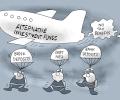
Around Rs 1 trillion, or a fifth of the investments made by alternative investment funds (AIFs) are questionable in terms of the intent behind the investments and are under the scanner for circumvention of regulations, said Ananth Narayan, whole-time member of Securities and Exchange Board of India (Sebi). AIFs are pooled investment vehicles that invest in a variety of assets including real estate, startups, unlisted companies, and derivative strategies in the listed space.

To shield against US President Donald Trump's tariff shock, analysts have been advising investors to focus on stocks of domestic-oriented companies, rather than export-centric ones, to minimise potential losses.

Promoters' ownership in private listed companies declined to an eight-year low of 40.58 per cent as of June 30, 2025, following a net share sale worth Rs 54,732 crore during the quarter, according to data from primeinfobase.com, an initiative of PRIME Database Group.

The real requirement for the finance minister's explanatory speech is to explain the measures taken in the Budget to influence inflation and growth not just through the announcement of a deficit goal, but more broadly through the impact on money supply, consumer demand, foreign trade and investment, explains Nitin Desai.

Reserve Bank of India (RBI) Governor Sanjay Malhotra on Wednesday said regulations should not create unintended barriers to financial inclusion while emphasising that the impact of regulations on individuals and businesses should be considered.

The draft digital personal data protection (DPDP) rules, which require banks to obtain explicit consent from their customers before using their data for purposes beyond the original intent, although is being followed in spirit, leaves no room for regulatory arbitrage, experts said. They said that the potential business impact is difficult to assess at this stage, but the formalisation of these rules will mean banks now need to establish clear data processing agreements with third-party entities to ensure compliance.

Pvt sector holds back, waits for key reforms

The move is part of a larger initiative by the government to speed up work in the highway sector.

These have always been pro-cyclical bets but new banks could erode RoEs.

GST Reform 2.0, which trims tax slabs from four to two, signals a push for demand-led growth, and together with recent income tax cuts, sets the stage for sustained economic growth, experts said. The Goods and Services Tax (GST) Council on September 3 approved an overhaul of the indirect tax regime by taxing essentials at 5 per cent and other goods at 18 per cent. A new 40 per cent tax will be applicable on luxury and sin items.

The Indian government has expressed its disagreement with the IMF staff's 'baseline' assumption that the 50 per cent US tariffs on its goods exports 'would remain in place indefinitely', based on which the staff pegged the country's GDP growth at 6.6 per cent this year, and pared its 2026-27 projection by 20 basis points to 6.2 per cent.

Sections in the US State Department and Pentagon have always felt more comfortable dealing with all powerful Pakistani generals instead of elected civilians, points out Rana Banerji, who headed the Pakistan desk at RA&W.

'Listing of scaled Indian subsidiaries of multinational corporations as well as of Indian conglomerates continues to remain a key theme for IPOs in India.'

Research and development (R&D) spending by BSE 100 companies has grown steadily, rising from 0.89 per cent of revenue in FY20 to 1.32 per cent in FY24, averaging around 1 per cent over the period in-between, according to data compiled from Bloomberg and company annual reports. Also, these companies more than doubled their R&D spending in absolute terms over these five years: From Rs 25,041 crore to Rs 63,072 crore. While this reflects a prioritisation of innovation, corporate R&D investment remains relatively conservative.
External auditor PwC is likely to submit its report to IndusInd Bank's board on Friday regarding accounting discrepancies in its derivatives portfolio, sources said. As per an estimate, Rs 2,100 crore discrepancy in accounting may impact 2.35 per cent of the bank's net worth.

Government announcements for the building of new roads, railways, and other capital expenditure (capex) projects may have hit an all-time low, according to numbers for the December quarter.

Hyundai Motor India Limited's (HMIL's) record Rs 27,870 crore initial public offering (IPO) may not have set the primary market alight with sky-high subscription levels, but it has spelled a windfall for the five investment banks steering the share sale. The Indian arm of the South Korean carmaker paid Rs 493 crore - 1.77 per cent of the issue size - in fees and commissions to the book running lead managers (BRLMs), marking the largest-ever payout for an IPO in the country.

Mint Road's proposals on banks' M&A funding are cautious even as entrants root for more elbow room, and weigh business models.

India's highways development project, the largest public private partnership programme in the world, is likely to attract a whopping investment of $41 billion, including FDI, from the private sector, Highways Minister Kamal Nath said.

India and Russia have solidified a five-year plan to enhance their economic and trade partnership, while also addressing the ongoing conflict in Ukraine and the threat of terrorism.

The government is likely to extend fiscal incentives for production of toys, bicycles and leather and footwear in the forthcoming budget as it looks to expand production linked incentive (PLI) scheme to cover more high-employment potential sectors, sources said. The government has already rolled out the scheme with an outlay of about Rs 2 lakh crore for as many as 14 sectors, including automobiles and auto components, white goods, pharma, textiles, food products, high efficiency solar PV modules, advance chemistry cell and speciality steel. The scheme aims to make domestic manufacturing globally competitive and create global champions in manufacturing, and it is yielding solid results, sources said.

If Rakesh Sharma represented the dreams of a nascent India looking outward, Shubhanshu Shukla embodies a confident India reaching for the controls.

Enthused by higher than expected GDP numbers in the fourth quarter of 2022-23, Chief Economic Adviser (CEA) V Anantha Nageswaran on Wednesday said India's economic growth may exceed the initial estimate of 6.5 per cent in the current fiscal and the country can look for another year of solid economic performance.

Capital expenditure by Indian companies is likely to see an uptick in the upcoming quarters as capacity utilisation has surpassed the critical threshold of 75 per cent, and numerous companies have deleveraged their balance sheets, according to analysts. The first quarter of the current financial year has shown improved profitability, driven by a decrease in input prices. This, according to analysts at Care Ratings, should stimulate a revival in the private capex cycle.

Fresh investments by corporates up just 5.8% in FY17, lowest since 1992

India's largest IT services company TCS believes that generative artificial intelligence (AI) is not just another tech cycle but a "civilisational shift" which will positively benefit every industry.

Equity benchmarks face a key test as investors weigh consumption revival hopes against tariff pressures and weak earnings. Amidst this, HSBC has outlined tailwinds and risks that could cap gains.

With demand for information-technology (IT) services in North America still sluggish, Europe has become a source of optimism for Indian companies because it is delivering steady gains over the past two years and continuing to outperform in the latest quarter. Yet analysts caution a full-scale revival will require a rebound in the United States (US), particularly in manufacturing, retail, and BFSI (banking, financial services, and insurance), because Europe contributes only about a third of the revenues.

Greater public and private participation is required in sectors such as railways, ports and power as India looks at investing USD 1 trillion in infrastructure over the next five years, Minister of State for Urban Development Saugata Ray said.

Brave statements such as we will continue to be the fastest growing large country are of no consolation, because the direction of trade also determines the flow of investment, points out M Govinda Rao.

If they act now, they can reshape the strategic map of Asia without firing a shot. If they wait, the next opportunity will come only after a serious Taiwan Strait incident -- by which time the price will be far higher, and the room for boldness far smaller -- the opportunity may well be lost by then. The question is no longer whether this can or should be done, points out Varun Arya.

'We are in a position to start due diligence and private data room access shortly.'

'We need to further catalyse economic growth and the government needs to increase revenue,' says G K Agarwal, BJP's national spokesperson on economic affairs.

'If the markets correct further, PSU stocks could continue to decline.'

'The barbell strategy says that the best way to strike a balance between risk and reward is to invest at the extremes of the risk spectrum.'

The weakening of inflation, prospects of economic growth, geopolitical uncertainty and comfortable system liquidity may result in the Reserve Bank of India's (RBI) Monetary Policy Committee (MPC) to cut the repo rate by another 25 basis points, opine top economists. They also said the external economic pressures like trade policies and others would require continued RBI's accommodative stance and policy support for the Indian industry to sustain the growth.

The value of private equity (PE)-backed mergers and acquisitions (M&As) in India reached a six-year low during the first seven months of the current calendar year, amid ongoing global uncertainties. The total value of these deals stood at $6.2 billion during the period, down from $9 billion in the same period last year, and lower than the $14 billion recorded during the corresponding period in 2019, according to data from LSEG Deals Intelligence. PE funds pool capital from investors, including high-net-worth individuals, to invest in high-return opportunities.

However, Tata Consultancy Services, Infosys, Tech Mahindra, UltraTech Cement, IndusInd Bank, Hindustan Unilever and ICICI Bank were the gainers.

As deposit growth lags credit expansion, Indian banks face shrinking low-cost Casa inflows, rising funding costs, and structural shifts driven by UPI, e-Kuber, and digital savings trends, points out Tamal Bandyopadhyay.

Quarterly earnings from corporates, global trends, and trading activity of foreign investors will guide market sentiment this week, analysts said, adding that benchmark indices may face volatile trends. "The upcoming release of Q2 results will be closely watched, providing insights into corporate performance. "Meanwhile, the escalating tensions between Israel and Iran introduce a significant geopolitical risk, potentially leading to increased oil prices and market volatility.
